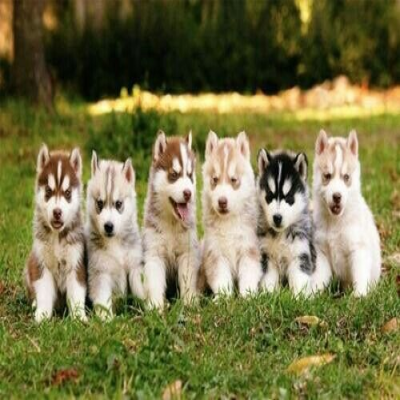
Husky
Looking for a Husky pup , Please do fill the the CONTACT US form
Happybark team will call you to guide through the process of connecting with an ethical breeder for the furry companion
Happybark helps you as follows:
1. Video of pups to choose the best pup
2. Connect with ethical breeder
3. Health report to be submitted to the pet parent
4. No to puppy mill
5. Vaccinated with certificate
Average sizes and life expectancy of the breed.
HEIGHT
21-23.5 inches (male)
20-22 inches (female)
WEIGHT
45-60 pounds (male)
35-50 pounds (female)
LIFE EXPECTANCY
12-14 years
General Appearance: The Siberian Husky is a medium-sized working dog, quick and light on his feet and free and graceful in action. His moderately compact and well furred body, erect ears and brush tail suggest his Northern heritage. His characteristic gait is smooth and seemingly effortless. He performs his original function in harness most capably, carrying a light load at a moderate speed over great distances. His body proportions and form reflect this basic balance of power, speed and endurance. The males of the Siberian Husky breed are masculine but never coarse; the bitches are feminine but without weakness of structure. In proper condition, with muscle firm and well developed, the Siberian Husky does not carry excess weight. Size, Proportion, Substance:
Height - Dogs, 21 to 23½ inches at the withers. Bitches, 20 to 22 inches at the withers. Weight - Dogs, 45 to 60 pounds. Bitches, 35 to 50 pounds. Weight is in proportion to height. The measurements mentioned above represent the extreme height and weight limits with no preference given to either extreme. Any appearance of excessive bone or weight should be penalized. In profile, the length of the body from the point of the shoulder to the rear point of the croup is slightly longer than the height of the body from the ground to the top of the withers.
Disqualification - Dogs over 23½ inches and bitches over 22 inches. Head: Expression is keen, but friendly; interested and even mischievous. Eyes almond shaped, moderately spaced and set a trifle obliquely. Eyes may be brown or blue in color; one of each or parti-colored are acceptable. Faults - Eyes set too obliquely; set too close together. Ears of medium size, triangular in shape, close fitting and set high on the head. They are thick, well furred, slightly arched at the back, and strongly erect, with slightly rounded tips pointing straight up. Faults - Ears too large in proportion to the head; too wide set; not strongly erect. Skull of medium size and in proportion to the body; slightly rounded on top and tapering from the widest point to the eyes. Faults - Head clumsy or heavy; head too finely chiseled. Stop - The stop is well-defined and the bridge of the nose is straight from the stop to the tip. Fault - Insufficient stop.
Muzzle of medium length; that is, the distance from the tip of the nose to the stop is equal to the distance from the stop to the occiput. The muzzle is of medium width, tapering gradually to the nose, with the tip neither pointed nor square. Faults - Muzzle either too snipy or too coarse; muzzle too short or too long. Nose: Black in black, gray, sable, or agouti dogs; liver in red dogs, black, liver or flesh-colored in white dogs. The lighter-streaked “snow nose is equally acceptable. Lips are well pigmented and close fitting. Teeth closing in a scissors bite. Fault - Any bite other than scissors.
Neck, Topline, Body: Neck medium in length, arched and carried proudly erect when dog is standing. When moving at a trot, the neck is extended so that the head is carried slightly forward. Faults - Neck too short and thick; neck too long. Chest deep and strong, but not too broad, with the deepest point being just behind and level with the elbows. The ribs are well sprung from the spine but flattened on the sides to allow for freedom of action. Faults - Chest too broad; "barrel ribs"; ribs too flat or weak. Back - The back is straight and strong, with a level topline from withers to croup. It is of medium length, neither cobby nor slack from excessive length. The loin is taut and lean, narrower than the rib cage, and with a slight tuck-up. The croup slopes away from the spine at an angle, but never so steeply as to restrict the rearward thrust of the hind legs. Faults - Weak or slack back; roached back; sloping topline. Tail: The well furred tail of foxbrush shape is set on just below the level of the topline, and is usually carried over the back in a graceful sickle curve when the dog is at attention. When carried up, the tail does not curl tside of the body, nor does it snap flat against the back. A trailing tail is normal for the dog when in repose. Hair on the tail is of medium length and approximately the same length on top, sides and bottom, giving the appearance of a round brush. Faults - A snapped or tightly curled tail; highly plumed tail; tail set too low or too high.
Forequarters: Shoulders - The shoulder blade is well laid back. The upper arm angles slightly backward from point of shoulder to elbow, and is never perpendicular to the ground. The muscles and ligaments holding the shoulder to the rib cage are firm and well developed. Faults - Straight shoulders; loose shoulders.
Forelegs - When standing and viewed from the front, the legs are moderately spaced, parallel and straight, with the elbows close to the body and turned neither in nor out. Viewed from the side, pasterns are slightly slanted, with the pastern joint strong, but flexible. Bone is substantial but never heavy. Length of the leg from elbow to ground is slightly more than the distance from the elbow to the top of withers. Dewclaws on forelegs may be removed. Faults - Weak pasterns; too heavy bone; too narrow or too wide in the front; out at the elbows. Feet oval in shape but not long. The paws are medium in size, compact and well furred between the toes and pads. The pads are tough and thickly cushioned. The paws neither turn in nor out when the dog is in natural stance. Faults - Soft or splayed toes; paws too large and clumsy; paws too small and delicate; toeing in or out. Hindquarters: When standing and viewed from the rear, the hind legs are moderately spaced and parallel. The upper thighs are well muscled and powerful, the stifles well bent, the hock joint well-defined and set low to the ground. Dewclaws, if any, are to be removed. Faults - Straight stifles, cow-hocks, too narrow or too wide in the rear.
Coat: The coat of the Siberian Husky is double and medium in length, giving a well furred appearance, but is never so long as to obscure the clean-cut outline of the dog. The undercoat is soft and dense and of sufficient length to support the outer coat. The guard hairs of the outer coat are straight and somewhat smooth lying, never harsh nor standing straight off from the body. It should be noted that the absence of the undercoat during the shedding season is normal. Trimming of whiskers and fur between the toes and around the feet to present a neater appearance is permissible. Trimming the fur on any other part of the dog is not to be condoned and should be severely penalized. Faults - Long, rough, or shaggy coat; texture too harsh or totoo harsh or too silky; trimming of the coat, except as permitted above.
Leave Your Comment
call us
+91 7660020250
Copyrights © 2024 happybark all right reserved.
Popular Search
- Farmina vet life obesity
- Royal canin satiety weight management
- Drools vet pro obesity
- Farmina vet life gastro